
The studio
A Room-by-Room Tour of 41 Union Square West, Suite 501
Everything you'll see and use before you ever book an hour — the floor, the apparatus, the waiting area, and how a client finds their way up.
41 Union Square West sits on the west side of the square, between 16th and 17th Streets, a prewar commercial building with a working elevator and a lobby directory that lists Suite 501 among the other professional tenants. It is not a walk-up, and it is not a converted apartment — it is a commercial floor built for exactly this kind of use, which matters the first time a client asks where to park or whether there's a doorman to buzz them in.
A client who has never been here before takes the elevator to the fifth floor and steps out into a short hallway. Suite 501 is the first door on the right. There's no guessing which unit, no second hallway to backtrack through — the studio's sign is at eye level and the door is propped open during business hours so a nervous first-timer doesn't have to knock and wait. That five-second detail — an open door instead of a buzzer — comes up more than you'd expect in client feedback from practitioners who've worked in less welcoming buildings.
Walking in
What a client sees in the first thirty seconds
The door opens onto the client waiting area — a small, deliberately uncluttered room with seating, a coat rack, and a spot to set down a bag before a session. It is not a retail counter and there is nothing for sale on it; the point of the room is to give a client somewhere calm to sit for the two or three minutes before their practitioner comes to get them, not to sell them anything while they wait. Square footage for the waiting area is [PLACEHOLDER — CONFIRM].
Natural light reaches the waiting area and much of the Pilates floor through windows along the Union Square-facing side of the suite. Practitioners who've rented rooms in interior, windowless suites elsewhere in the city notice this immediately — daylight changes how a room reads to an anxious new client, and it changes how energized an instructor feels teaching a 7am session in January.
The Pilates floor
Where the reformers, towers and chairs live
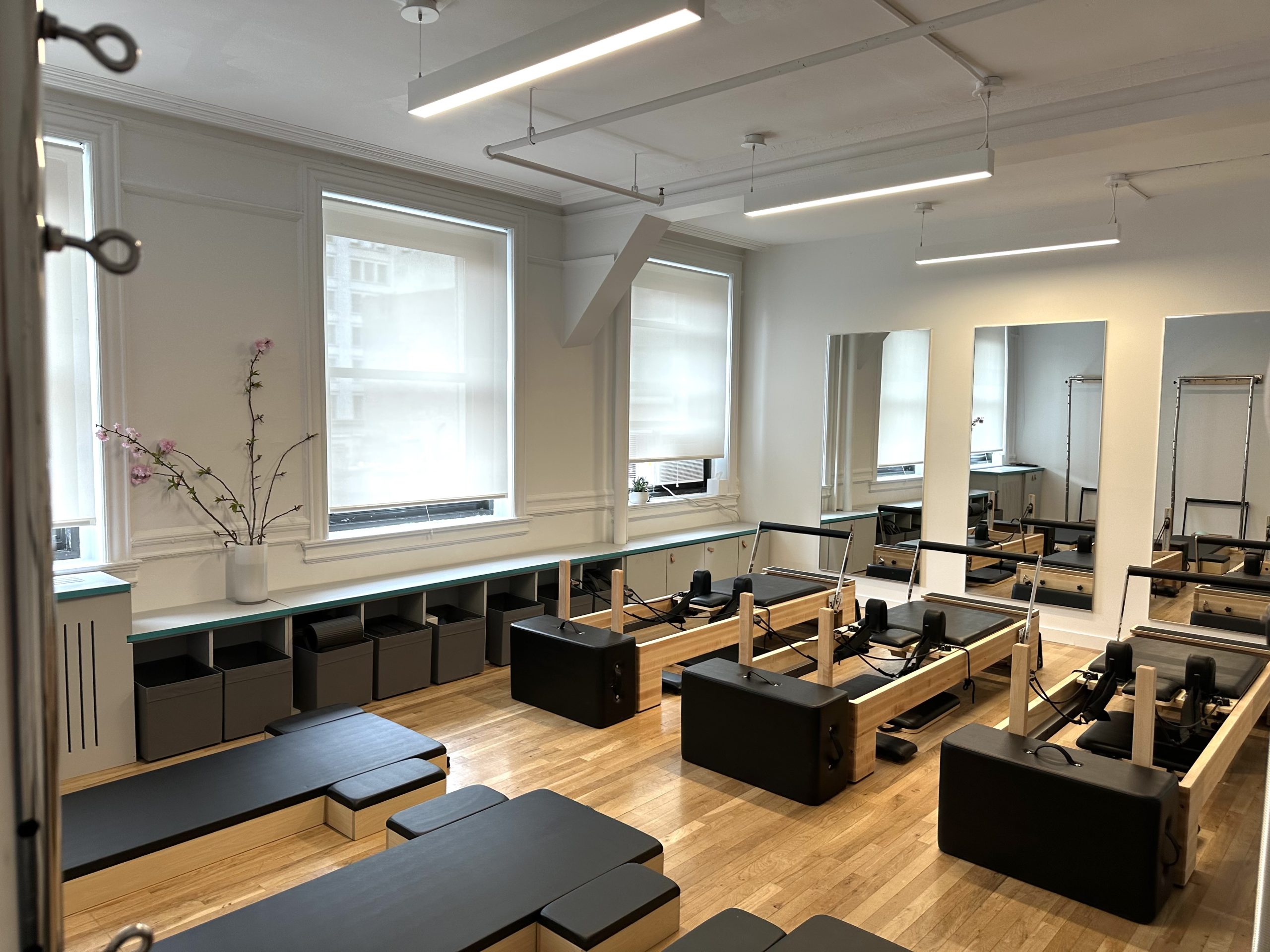
Past the waiting area, the Pilates floor is the largest room in the suite — dimensions are [PLACEHOLDER — CONFIRM] — and it's laid out with enough space between apparatus that two practitioners can run sessions side by side without either client feeling like they're training in someone else's lesson. Reformers sit along one wall, wall towers are mounted along another, and the wunda chairs, ladder barrels and spine correctors are arranged so an instructor can move a client from one piece of equipment to the next without a break in the session to relocate mats and props.
Ceiling height, again [PLACEHOLDER — CONFIRM], is generous enough that overhead spring work on the towers and standing work on the reformer's footbar don't feel cramped. Flooring is a resilient surface suited to bare feet and grip socks, not carpet, which matters for anyone doing floor-based mat work between apparatus stations.
Comfort controls
Lighting, sound and climate, room by room
Every part of the suite is set up so a practitioner can control the room rather than adapt to it. Dimmable lighting lets an instructor set a bright, energetic tone for a morning session or a quieter one for an evening client, rather than the flat fluorescent overhead most rental suites default to.
Sound is controlled independently across the space — each area has its own volume control, so a session on one side of the suite isn't competing with a reformer's springs releasing on the other. Air conditioning is zoned as well, which matters for clients moving hard on a summer afternoon and for an instructor teaching back-to-back sessions in the same room all day.
Restrooms, storage and the practical stuff
What's easy to overlook until you need it
Restrooms are shared and located just off the main corridor, stocked with hand soap and paper towels and cleaned as part of the studio's regular housekeeping — not something a renting practitioner needs to arrange or supply themselves. Storage for practitioners who keep a kit on site — extra linens, a rolling cart, a bag of props — is available; ask about current availability when you book a tour, since allocation depends on what's free that month.
Clean linens, hand towels, bath towels, hair ties and hand sanitizer are stocked in a linen closet near the Pilates floor and replenished daily, so a practitioner never has to run a load of towels between clients or plan a laundry pickup around their own schedule.
Getting here
Elevator access, the building, and the walk from the subway
41 Union Square West is served by a passenger elevator that runs to Suite 501, so there's no walk-up for a client carrying gear, using a cane, or simply not wanting to climb five flights before a session. The building sits directly on Union Square Park, three to five minutes on foot from the 14th Street–Union Square station, where the 4/5/6, N/Q/R/W and L lines all converge — 4/5/6, N/Q/R/W and L at 14th St–Union Square. For a practitioner building a client list, that kind of transit access is a real selling point: clients from Brooklyn, the Upper East Side, Chelsea and the East Village can all reach the studio without a transfer.
The building itself is a commercial office building with normal business-hours security at the lobby desk; visitors give the tenant name (Enhancewell, Suite 501) at the desk if asked, though during studio hours the fifth-floor door is typically propped and easy to find without an escort. If you're touring for the first time, we'll walk you from the lobby up so you know exactly what your own clients will experience on their first visit.
See it yourself before you book.
Photos and descriptions only go so far. A 20-minute walkthrough with Dana or Antoni answers the questions that matter to your specific practice.