
Reformer Pilates, explained
What Is a Pilates Reformer? A Practical Guide
How the machine works, what the springs actually do, the exercises you'll see most often, and how reformer work compares to mat Pilates.
The basics
What is a Pilates reformer?
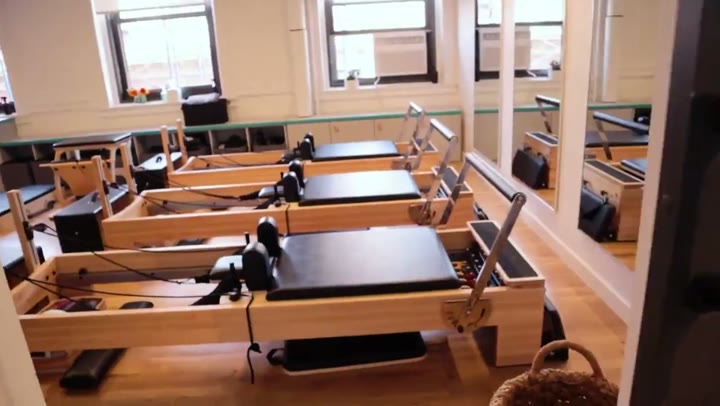
A Pilates reformer is a bed-shaped frame with a flat, wheeled platform called the carriage that slides back and forth along tracks. Springs attached to one end of the frame connect to the carriage and resist its movement, so pushing or pulling the carriage against the spring load is what creates the exercise.
A sliding headrest and shoulder blocks anchor the upper body, adjustable straps with handles let a client work the arms while lying, seated or standing on the carriage, and a footbar at one end gives a surface to push against with the feet or hands. Ropes, a jump board attachment and a box that sits on the carriage extend the range of exercises further.
Joseph Pilates originally built the earliest reformer-style equipment — he called his full system "Contrology" — from adapted bed frames and springs in the early twentieth century. Modern reformers keep the same working principle: a moving carriage, resisted by springs, that a body pushes against in a controlled, repeatable range of motion.
Resistance
How do the springs create resistance?
Each spring attaches to the carriage on one end and to the frame on the other. Springs are usually color-coded by tension — a common setup uses light, medium, heavy and extra-heavy springs, often four to five in total — and an instructor combines them to dial in resistance for a specific exercise and a specific client.
Counterintuitively, fewer or lighter springs often make an exercise harder rather than easier. Removing springs reduces support from the carriage, which shifts more of the stabilizing work onto the client's own core and hip muscles. Heavier springs make the carriage harder to move but also support body weight more, which is why beginners frequently start on heavier spring settings for footwork and lighter settings only once their control improves.
Because tension can be changed in seconds between exercises, a single reformer session can move from a heavy-spring, supported warm-up to light-spring, high-control work without switching equipment — one reason reformer sessions can pack a wide range of exercise types into 55 minutes.
Common exercises
What exercises show up in most reformer sessions?
Footwork
Lying on the carriage with feet on the footbar in several positions — heels, toes, arches, a V-stance — pressing the carriage out and controlling its return. Usually the first exercise of a session; it warms the legs and teaches carriage control before harder work.
Long stretch series
A plank-like position with hands on the footbar and the carriage moving under the body's own control. Builds shoulder stability, core control and coordination between upper and lower body — a staple of intermediate and advanced sessions.
Short box
A box is placed on the carriage and the client sits on it, feet strapped under the footbar, performing seated flexion, extension and rotation. Targets spinal articulation and deep abdominal control in a seated position most mat exercises don't reach.
Beyond these three, a typical session touches leg circles and frog for hip mobility, rowing series for upper-back and shoulder work, and stomach massage series for seated core control. An instructor sequences exercises to move the body through most planes of motion — flexion, extension, rotation and lateral movement — within a single 55-minute session.
Comparison
Reformer vs. mat Pilates — what's the actual difference?
Mat Pilates uses body weight and gravity as the only resistance; the reformer adds adjustable spring resistance and a moving carriage. That means the reformer can be made easier than a mat exercise (heavier springs support more body weight) or harder (lighter springs and unstable carriage movement demand more stabilization) — a range mat work alone cannot offer.
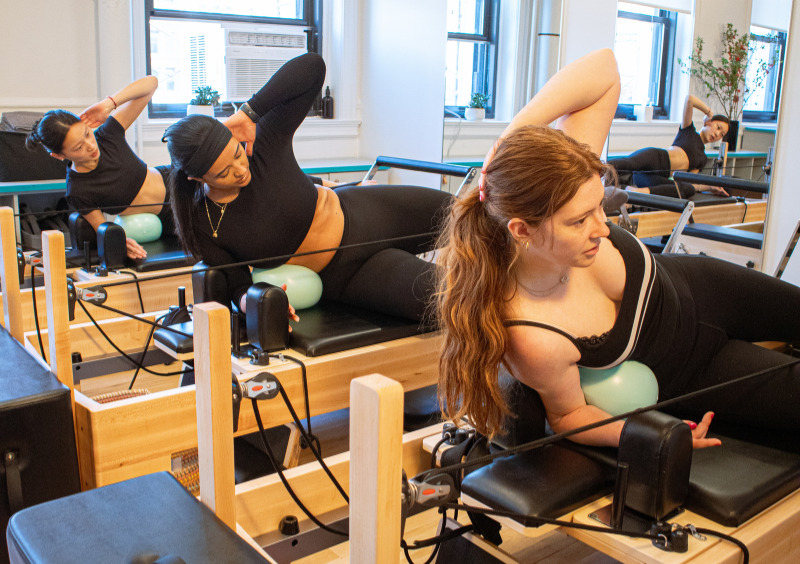
The reformer's straps, footbar and carriage also allow standing, kneeling and side-lying exercises that are difficult or impossible to load correctly on a flat mat. Many instructors treat mat work as the foundation — breath, neutral spine, basic abdominal sequencing — and the reformer as where that foundation gets tested against resistance and instability.
Neither is strictly "better" — they train overlapping but not identical qualities. A client who has only done mat classes often finds the first reformer session changes how an exercise they thought they knew actually feels, because the sliding carriage exposes control gaps that a stationary mat does not.
Why it's low-impact
Why is reformer Pilates considered low-impact?
Almost every reformer exercise happens lying, seated or kneeling on the carriage, with the spring system absorbing and controlling movement rather than the joints absorbing impact against a hard floor. There is no running, jumping (aside from optional jump-board attachments) or ballistic movement in a standard session — the carriage moves smoothly along its tracks at whatever speed the client controls.
That controlled, supported quality is why reformer work is common in general-fitness programming for people easing back into structured movement, and why athletes often use it on recovery days between higher-impact training. It is not a substitute for medical rehabilitation, and anyone recovering from an injury or surgery should be cleared by their physician or physical therapist before starting.
Try it
See it on our apparatus.
Frequently asked questions
Is the Pilates reformer good for beginners?
Yes. The carriage and springs support body weight through the movement, which makes many exercises easier to control than the equivalent mat move. A beginner's first session usually starts at light spring tension with an instructor cueing every position, which is safer than learning the same exercises unsupervised on a mat.
How many springs does a reformer use?
Most reformers have four to five color-coded springs that can be used in different combinations, giving a wide range from very light resistance for rehab-style work to heavy resistance for advanced strength exercises. The exact number and color scheme vary slightly by manufacturer.
Can the reformer help with back pain?
We are not a medical provider and make no claims to treat or cure back pain. Reformer work is often used as part of general fitness by people who have already been cleared by a physician or physical therapist, since the horizontal, supported carriage reduces spinal loading compared with many standing exercises — but any pain condition should be evaluated by a medical professional first.
Is reformer Pilates a good workout for building muscle?
It builds muscular endurance, control and stabilizer strength more than the kind of maximal-load hypertrophy a barbell program builds. Many athletes and lifters use it alongside strength training rather than instead of it.
Book
Try the reformer with an instructor beside you.
Sessions run at 41 Union Square West, Suite 501, New York, NY 10003. Tell us your experience level and we'll set the right starting point.