
For physical therapists
Physical Therapy Space for Rent in NYC — Union Square Pilates Apparatus Floor
A private Pilates studio with reformer, tower and barrel apparatus for loaded progressions, plus clear floor space for manual assessment work. Rent by the hour, keep your own patients, and pay nothing for the weeks you are away.
The cash-pay problem
Leaving the clinic is the easy part. Finding a room is not.
Most physical therapists who go independent in New York do not leave because they stopped liking the work. They leave because a productivity target turned a 45-minute evaluation into two overlapping 20-minute slots, and because the treatment they believed in kept getting trimmed to fit a billing code. The plan after that is usually the same: a small cash-pay caseload, an hour per patient, and enough control over the room to actually finish a session.
The obstacle is almost always the space. A commercial lease in Manhattan means a personal guarantee, a five-year term and a buildout budget before your first patient walks in — for a caseload that starts at four people a week. Renting a corner of a commercial gym solves the cost problem and creates a worse one: no door, no quiet, and a patient doing a graded loading progression six feet from a dropped dumbbell.
Renting hourly at 41 Union Square West, Suite 501, New York, NY 10003 sits between those two. You book the hours your patients are actually on the calendar, at $40 for the apparatus floor, and the weeks you take off cost you nothing. There is no lease, no guarantee and no split of your fee.
What a PT session actually needs from a room
A physical therapy session is two different sessions in one hour. The first half often needs a table, privacy and quiet: soft tissue work, joint mobilization, a manual assessment where the patient reports what they feel and you need to hear it. The second half needs load, space and equipment: sit-to-stands with resistance, single-leg work with something to hold, eccentric loading a patient can control without dropping anything.
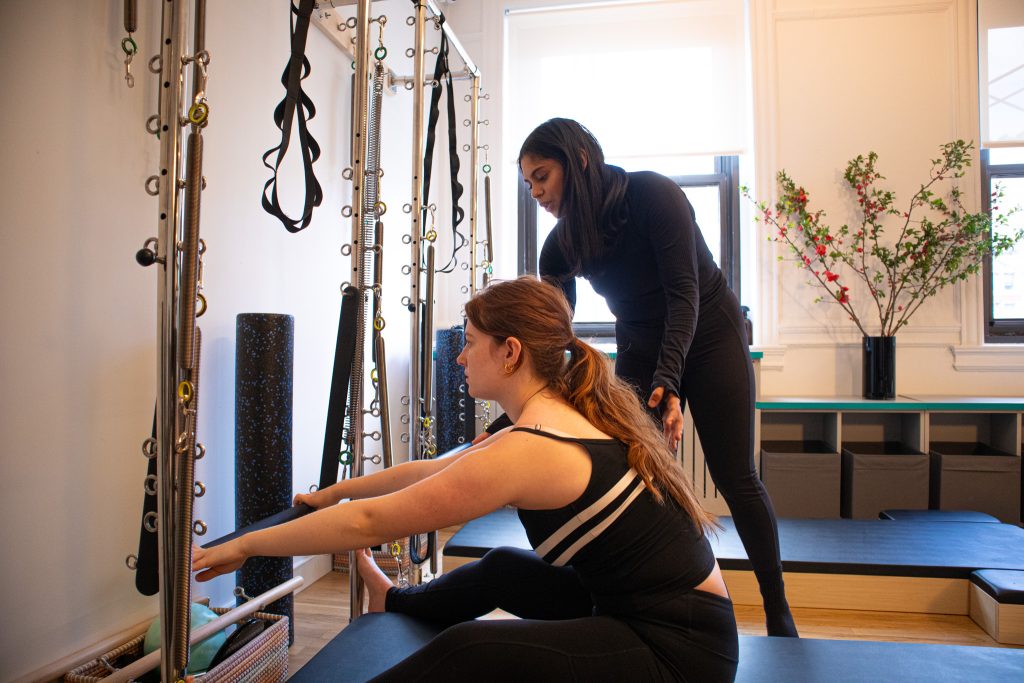
Rooms that serve one half of that well usually fail at the other. A bare table room has no floor space to load a patient. A gym floor has load and no privacy. Here the two live in the same private suite: clear floor and a closed door for hands-on assessment work, and the Pilates floor with reformer, tower and barrel apparatus for the loading half. Spring resistance in particular gives you graded, assisted load in supine and side-lying positions that a free weight cannot replicate for a patient who is not yet ready to bear full body weight.
What is here
Equipment you would otherwise be buying
Pilates floor
- Reformers
- Towers
- Wall Towers
- Wunda / High Chairs
- Ladder Barrels
- Spine Correctors
- Mats
- Magic Circles
- Foam Rollers
- Resistance Bands
- Weights
- Props
Comfort & shared amenities
- Independently controlled room music and volume
- Dimmable lighting
- Air conditioning
- Bolsters, cushions and covers
- Yoga and Pilates mats
- Private client waiting area
How PTs use the space
Table first, apparatus second, same booking
The most common pattern among rehabilitation-minded renters is a single longer block: manual work and reassessment on the clear floor space, then a move onto the reformer for the loading portion while the tissue response is still fresh. Because it is all in the same room, the patient doesn't rebook a second appointment somewhere else to finish the session.
The second common pattern is a straight hour on the apparatus floor for patients who are past the manual phase and into progressive loading — post-operative knees working through range, a runner rebuilding calf capacity, an older patient training balance and hip strength with the safety of the reformer footbar and straps. The tower and barrel give you positions for spinal extension and thoracic mobility that most clinic gyms simply do not have.
You control the schedule either way. Booking is by the hour, with recurring weekly holds available for patients on a fixed plan of care. Classes can be cancelled up to 12 hours before the start time and the credit returns to your account. Private sessions need 24 hours. Professional rental bookings follow the 12-hour window, because the room is held out of the calendar and no one else can use it.
What Enhancewell does not do
We rent space. We do not refer patients to you, take a percentage of your fee, supervise your practice, or hold any part of your clinical documentation. Nothing here is a clinic affiliation and nothing here is medical oversight — you practice under your own New York license and your own liability coverage, and your patients are your patients.
Credentials we ask for
Before your first booking we collect a copy of your current New York State physical therapy license and your professional liability certificate. It takes a few minutes during onboarding and it is the reason the renter roster stays what it is: licensed clinicians and certified instructors, rather than whoever answered an ad.
The math
A caseload of six does not justify a lease
Run the honest version of the numbers. A cash-pay practice that starts with six patients a week needs six hours of room time — plus a little turnover. Under hourly rental at $40, that is what you pay for. Under a lease, you pay for 168 hours a week whether anyone is in the room or not, plus utilities, plus the apparatus, plus the buildout, plus the guarantee you personally signed.
The threshold worth watching is the point where your booked hours start filling most of a working week consistently, month after month. Until you are there, hourly rental is not the compromise version of having your own space — it is the arithmetically correct answer.
Getting patients here
An address a patient with a limp can actually reach
Access matters more in physical therapy than in almost any other practice, because a meaningful share of your patients are in pain, post-operative, or moving slowly. 41 Union Square West, Suite 501, New York, NY 10003 sits directly above 4/5/6, N/Q/R/W and L at 14th St–Union Square, which means most Manhattan patients arrive without a transfer and without a long walk from the platform. Patients coming from Gramercy, the Flatiron blocks or the East Village are usually within a ten to fifteen minute walk.
The building has an elevator to the fifth floor and a quiet private waiting area, so a patient who arrives early is not standing in a corridor. When someone is deciding whether to keep a twelve-visit plan of care, how hard the trip is turns out to matter as much as how good the session was.
Frequently asked questions
Can I run cash-pay physical therapy out of a rented room here?
Yes. Renters here are independent practitioners who bill their own clients directly — Enhancewell rents you the room and the equipment, it does not employ you, refer to you, or take a percentage of your fee. What you charge, how you document, and how you handle any out-of-network reimbursement paperwork stays entirely between you and your client.
Is the space set up for manual therapy as well as exercise?
Yes. The Pilates floor gives you reformer, tower and barrel apparatus for loaded, closed-chain progressions, and the room has clear floor space and a private waiting area for the manual assessment and reassessment work that bookends a loading session. Practitioners who work this way typically book a single longer block and move between manual work and the apparatus within it.
Do I need my own liability insurance and New York PT license?
Yes to both. You must hold a current New York State physical therapy license and your own professional liability coverage naming you as the practitioner before your first booking. We ask for copies during onboarding and keep them on file — that requirement is what keeps the renter roster professional and is not negotiable.
Can I store a plinth, bolsters or my own modalities equipment?
Storage is available for regular renters and is assigned rather than open-shelf, so nothing you leave sits in a shared pile. What fits depends on current renter volume — [PLACEHOLDER — CONFIRM available storage dimensions]. Bring what you need for a session in a bag if you are booking occasional hours rather than a recurring block.
Will a patient walking in think this is a clinic?
It reads as a private studio rather than an outpatient clinic — quiet floor, private waiting area, no reception queue and no shared gym floor with music. For cash-pay patients who left a high-volume clinic precisely because they were being seen three at a time, that difference is usually the selling point rather than a problem.
Can I book a recurring weekly slot for a plan-of-care patient?
Yes. Recurring weekly blocks are the most common arrangement for PT renters, because a plan of care runs on a fixed cadence and both you and the patient need the same hour each week. Recurring holds are confirmed in advance rather than booked session by session.
Book a studio tour
Next step
Come see the space.
Walk the apparatus floor, check the clear floor space for manual assessment, and ask what license and insurance paperwork you'll need before your first patient.
Tours take about 20 minutes at 41 Union Square West, Suite 501, New York, NY 10003. Prefer to talk first? Call (917) 999-8553.